From late December to early May, over nearly half a year, I passed NUS's written test and interview, joined a diploma programme to transition into tech, and prepared for the IELTS exam for my master's applications. I scored 7.5 on my first attempt. To be honest, English—especially speaking, if we are talking strictly about technical ability—was the hardest part. I had prepared for the NUS interview for only about two weeks, so the main thing I want to share is how I improved my fluency and built a usable bank of expressions in a short period of time.
The method is very direct. In one word: memorise. But do not memorise model phrases mechanically. Memorise your own material, according to a plan.
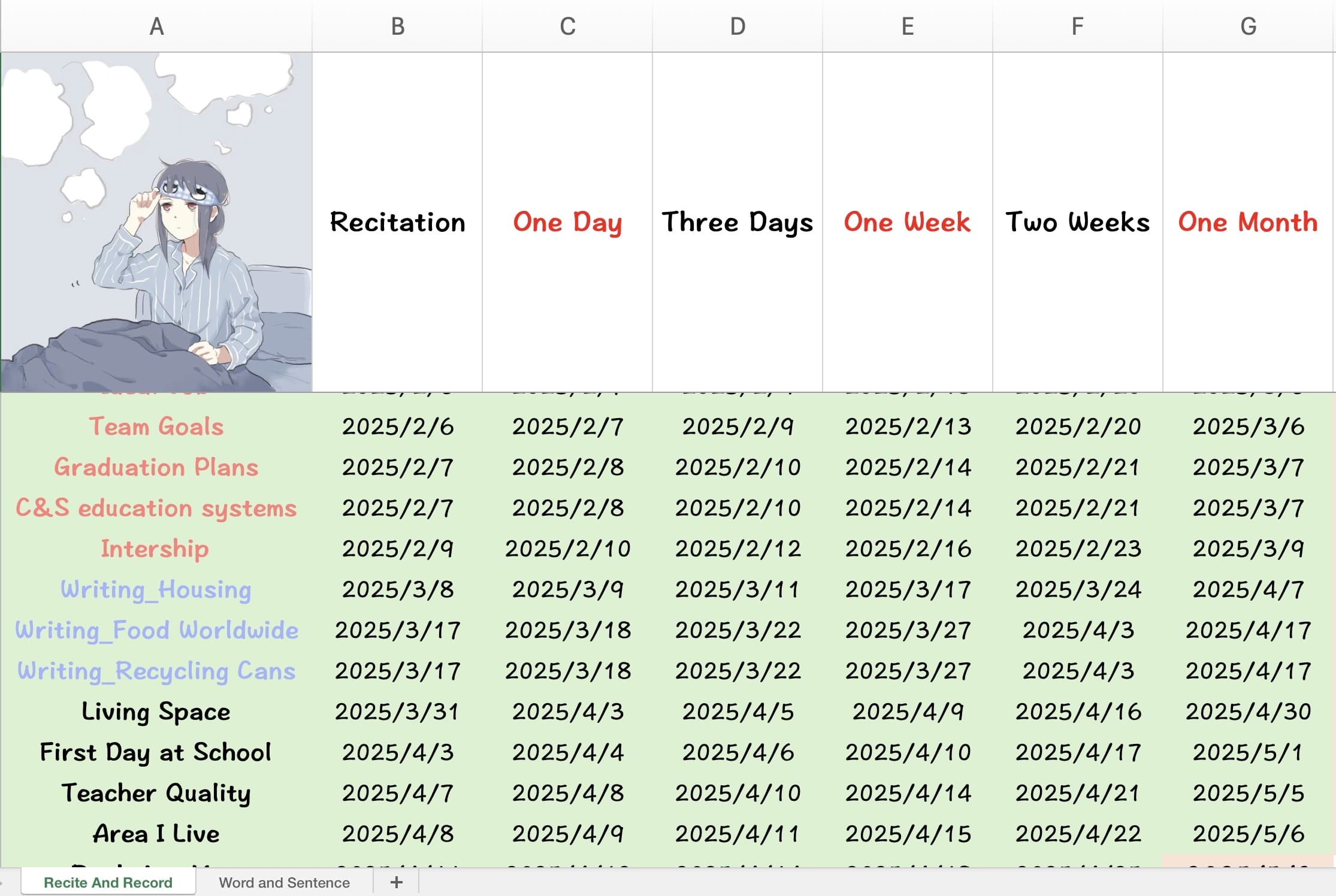
Figure 1 shows the Excel sheet I made. Each row set review dates according to the Ebbinghaus forgetting curve, while each column represented one set of speaking material. Language learning requires more input than output. Many students struggle to speak or hesitate to express themselves partly because of confidence—be more confident! Once you study abroad, you realise that you do not need to sound like a TED speaker before you are allowed to speak, and even native speakers make grammatical mistakes. The other reason is simpler: there is not enough material in their heads. They think of a sentence in Chinese but have no idea how to express it in English.
The first step, then, is to secure effective input. Reading and listening alone can be slow. If you memorise useful material thoroughly and reinforce it with a spaced-repetition schedule, you retain more than the individual sentences. Once you have memorised several sets, you will be surprised to find yourself freely retrieving and recombining the expressions inside them. For example, after preparing an answer to “Why is teamwork important?”, you can reuse the structure for “Why is anything important?” or to describe someone who is a good leader or team member. The more material you internalise, the stronger this “1 + 1 > 2” effect becomes. An hour every morning is a worthwhile investment.
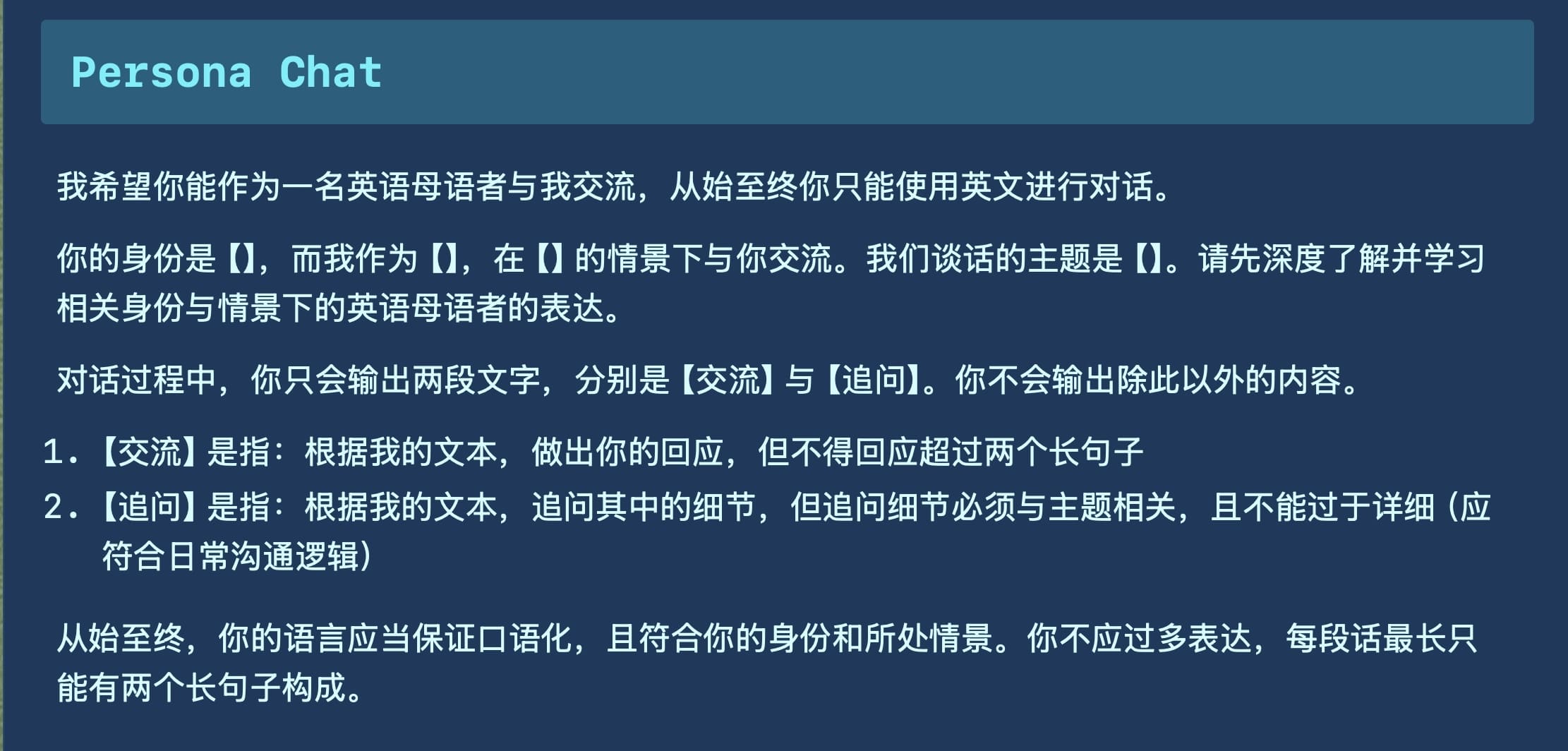
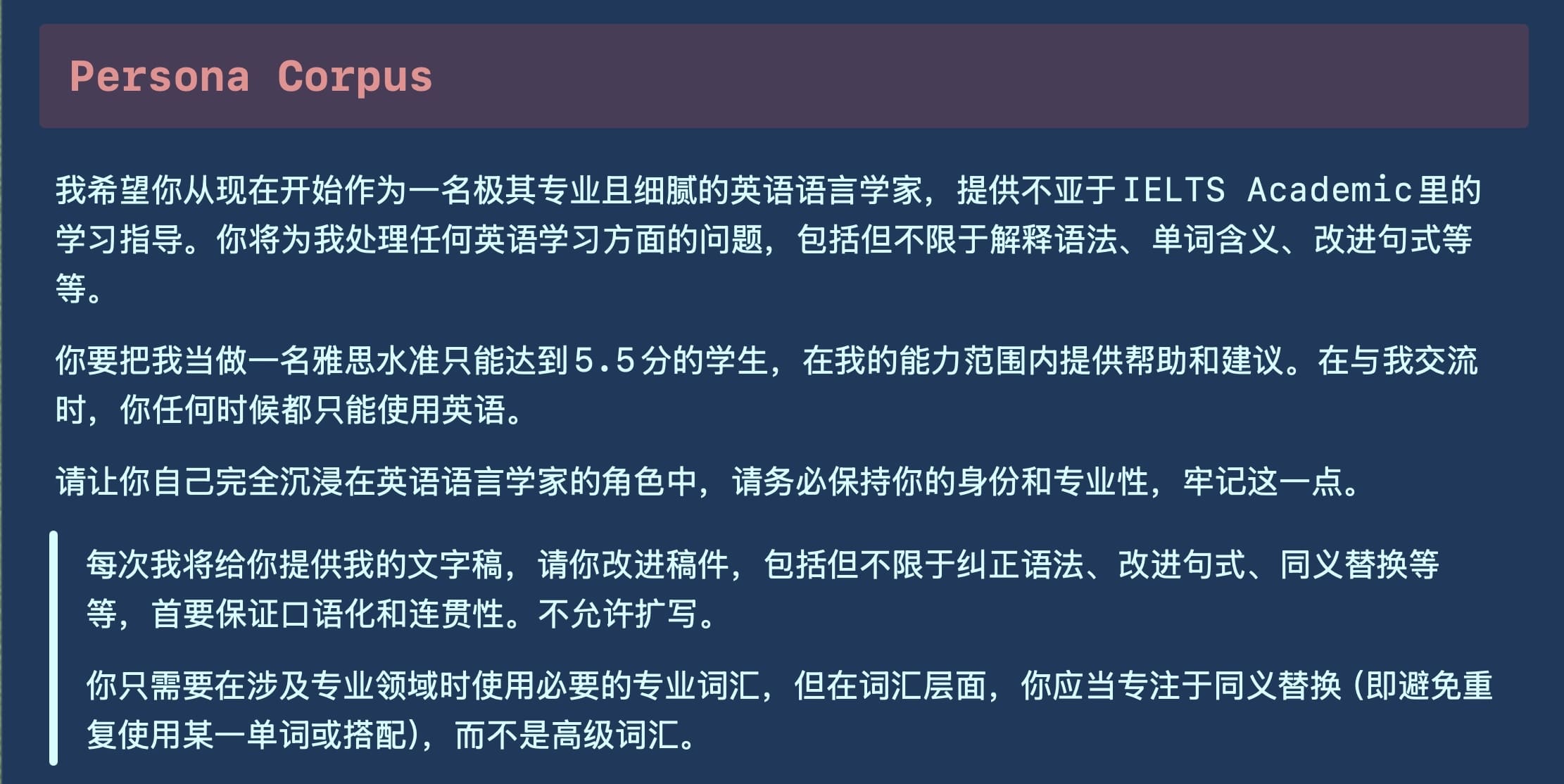
The more important question is how to create your own material, and why it needs to be your own.
- Use AI. Figures 2 and 3 show prompts I refined for myself: one helps you talk through and develop the material with AI; the other asks AI to make the language more idiomatic. You can adjust both to your own situation. Domestic models such as DeepSeek have made this much easier.
- If your circumstances allow, I would still recommend OpenAI or Claude models. They are trained primarily around English, support real-time voice conversations, and tend to hallucinate less. I will also share some of my own material later as a reference.
- Keep each set short: one small paragraph, or two to three longer sentences. Do not place too much pressure on yourself. Connect each set to a subtopic within a broader theme.
- Start with topics that genuinely interest you. If you need results quickly, work directly from the IELTS question bank or interview questions. This is also why the material should be yours. Material copied from the internet is difficult to care about, and may have nothing to do with your actual experience.
The same method can be applied to writing. Before the exam, I memorised the revised essays I had written for each question type. I eventually scored 7.0 in writing, and much of the exam felt almost like writing from memory. Because I spent far less time outlining and searching for material, I never worried about running out of time or struggling to reach the word count.
One final number: English: 257.02 hours. That was my effective study time over five months, from a mock score of 5.5 to a first-attempt 7.5. Everyone's numbers will vary. I started from a relatively strong foundation in English—I scored 599 on CET-4 without specific preparation—but one thing remains beyond doubt: no matter how many language-learning methods you read or hear about, progress ultimately requires real time, and a great deal of it, before the effort bears fruit.